Every year, Surviving Economic Abuse (SEA) attends party conferences from across the political spectrum to bring victim-survivor voices into conversations and highlight what needs to change to tackle economic abuse.
Below, our Policy and Public Affairs Officer, Nyan San Lwin, shares her key reflections from her first party conference.
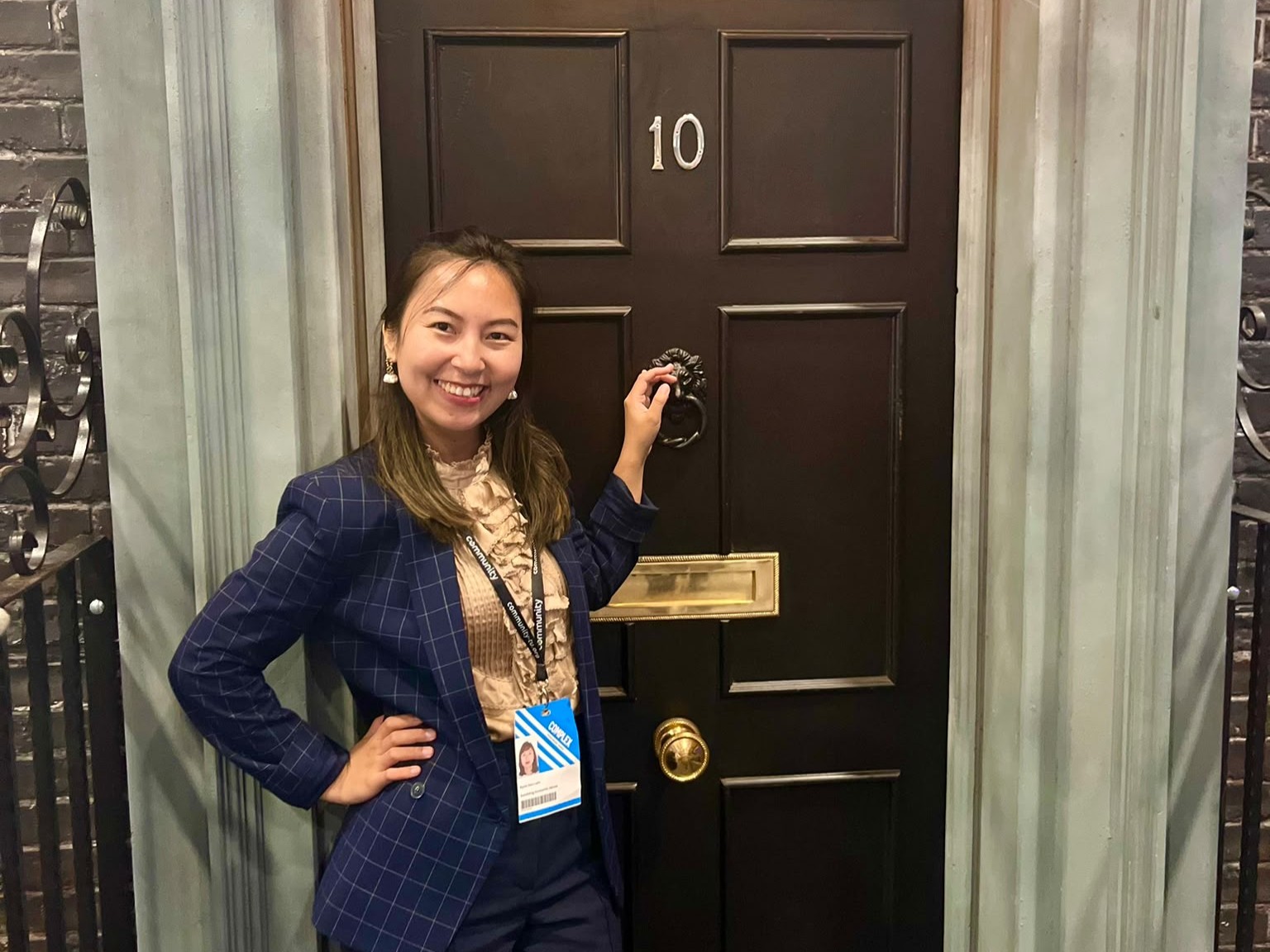
It may look like I am standing in front of the infamous Larry the Cat’s residence in SW1 London. But the truth is that I was in Liverpool, representing SEA at Labour Party Conference to bring victim-survivor voices into relevant conversations and highlight what needs to change to tackle economic abuse.
For someone who loves moving at the intersection of policy, politics and people, it was a little like Disneyland. Once we got inside the secure zone, I found myself surrounded by well-dressed professionals, including some women with very impressive power outfits of various colours. “This is Political Fashion Week,” I said to myself. But beyond the outfits, busy schedules and considerable caffeine consumption, five things stayed with me.
The role of male allyship in tackling gender-based violence
On our first day, we managed to squeeze in an event where Angela Rayner MP shared her experience of navigating a political career while juggling being a woman, a mother and a wife. She spoke about the different types of men women may encounter – some proactively pave the way for women to succeed; some could use a little nudge to move out of the way so women can step up and lead; and some still don’t quite get why we are banging on about feminism and all that stuff.
That speech made me think about the importance of closing gender and ethnicity pay gaps, flexible working policies and parental leave. For women facing intersecting inequalities, the glass ceiling can be multi-layered. There are already too many layers to break through to realise their potential.
Later at the Violence Against Women and Girls (VAWG) rally, Alex McIntyre MP made a powerful point about the importance of male allyship and accountability in truly tackling VAWG. His contribution added another dimension to that reflection: the responsibility men have in challenging the attitudes and behaviours that allow abuse to continue.
For me, these conversations highlighted how much men can do with the influence they already have, whether that means opening doors for women, challenging misogyny or holding other men accountable. We need more men proactively paving the way.
Economic abuse is gaining recognition, but that understanding needs to reach every postcode
I was particularly struck when the Economic Secretary to the Treasury walked into an event as a panellist and immediately set out that tackling economic abuse and financial coercion was her personal commitment and a priority as City Minister. She even gave a special shoutout to SEA.
As public affairs professionals do, I approached her afterwards, introduced myself and thanked her for the special mention. She said, “Walk with me, I don’t want to be late for another event.” I didn’t walk with her, frankly because I only realised five seconds later what she meant. By then, someone else had already grabbed her attention. I blame my hearing capacity, but in my defence, it was incredibly hard to hear anyone in a small and bustling room.
It was encouraging to hear her commitment to tackling economic abuse. Conversations across justice, education and health also highlighted its relevance beyond any single department. Yet her acknowledgement that even politicians may struggle to identify economic abuse experienced by their constituents showed why awareness remains essential. The recognition we heard at conference needs to spread into the services and institutions victim-survivors encounter in their everyday lives, in every postcode. If someone turns to their MP or local council for help, we want them to recognise what is happening and know how to respond.
Tackling economic abuse must be part of giving young people a better future
One of the highlights of the conference was sitting in the auditorium listening to the Prime Minister’s speech.
As a self-proclaimed speechwriter who has been writing Sam’s brilliant speeches (in my humble opinion) I found myself analysing the structure and speechmaking as much as the policy announcements. It was the first leader’s speech I had listened to in the room, and it will remain memorable for that reason.
The emphasis on supporting young people into education and employment offered an important opening. But for some girls and young women, those opportunities remain out of reach because someone is controlling their money, saddling them with mountains of debt, preventing them from studying or making it difficult to stay in work.
If we want to give young people a better future, we need to understand what is holding them back in the first place. Economic abuse must be part of that conversation.
Our discussion with the Skills Minister about including economic abuse in work on misogyny and financial literacy was a promising step. It offered an opportunity to connect the prevention of abuse with the wider ambition to help young people build independent lives.
Ambition must translate into changes in the systems survivors rely on
Monday was a jam-packed day for our team. We supported our CEO Sam in one-to-one meetings to build strategic working relationships, attended events where we raised economic abuse, and squeezed in networking coffees and dinners along the way.
Across those conversations, we discussed practical opportunities for change, from family justice reform and credit restoration to insurance product design.
These can sound like quite different areas of work. For someone trying to escape economic abuse and rebuild their life, they are closely connected. A court decision, a damaged credit file or an unsuitable financial product can each create more barriers to safety and independence.
The Prime Minister’s focus on making essential systems work better for people felt particularly relevant here. Tackling economic abuse needs coordinated action from the organisations victim-survivors rely on, including those that may not immediately see responding to abuse as part of their day job.
That is why conversations with financial services firms, public services and other partners matter alongside our engagement with politicians. The next task is to turn the ambition and encouraging conversations into concrete commitments, clear responsibilities and changes victim-survivors can feel.
Politics is much bigger than the people we see on telly
We tend to think about politics through the politicians we see on television or read about in the news. What became much more apparent to me at conference was the wider, more complex web of people working behind the scenes to make change happen.
There are advisers, civil servants, councillors, MPs’ staff, campaigners, charities, businesses and many others who help shape ideas and turn them into practical proposals. For SEA, victim-survivors’ experiences need to inform those conversations.
Even getting into the right room takes work. Before Liverpool, there were events to track, emails to send, diaries to coordinate, logistics to arrange, briefings to prepare and strategic opportunities to identify. Once the preparations were out of the way, it should have been an easy ride. Famous last words.
At one panel, I was ready to raise a question about economic abuse. But in a room full of people trying to do the same for their organisations, with very little time for questions, the opportunity didn’t simply fall into my lap.
I took Sara’s advice: sit in the front row, wear something bright and keep politely raising my hand until I was selected. It worked. I also learned that public affairs professionals sometimes have a window of just a few seconds to make their point and get someone interested. If we are lucky, we get a longer meeting, but that usually follows months of planning, engagement and relationship-building.
The magic potion for effective influencing seems to be striking a balance between being persistent but polite, persuasive but concise, approachable but challenging enough. I think.
After Liverpool
My personal highlight came towards the end of conference, when people gathered in a poorly lit room to rally for tackling violence against women and girls.
Yvette Cooper’s speech stayed with me. She spoke about violence against women and girls in the UK and internationally, including the violence facing women and girls in conflict.
For someone who found refuge in the UK after coming from a country run by dictators, I found myself shedding tears. I know too well that some of the things we take for granted are still out of reach for many women and girls: access to education, basic safety and the ability to make decisions for themselves.
I came away with a refreshed commitment to tackling violence against women and girls wherever it happens.
As I suspected, attending conference turned out to be the easiest bit for me. I made new connections, reconnected with familiar faces and learned so much, including not to book accommodation on one of the busiest streets in Liverpool city centre.
Too much caffeine was consumed, and too many sleeping hours were sliced, but I would enthusiastically do it all over again.
Until then, you can find me at my desk writing follow-up emails and drafting letters to keep the momentum going from Liverpool. Those conversations have given us opportunities. Now comes the work of making them count for victim-survivors.